Mission green: How smart buildings drive corporate sustainability?
For years, sustainability was mostly a reporting exercise. It sat near the back of the annual report, a handful of targets and a reassuring paragraph, and everyone moved on. What has changed is that the numbers stopped adding up unless the building cooperated. An office runs through enormous amounts of energy just going about an ordinary Tuesday, and no amount of offsetting really fixes a building that leaks it. So companies have quietly redirected their attention from the promises in the report to the machinery in the basement.
That is how smart buildings ended up at the heart of corporate sustainability. Some people reach for a tidier phrase, mission green buildings, but what it comes down to is unfussy. A building that can tell when a floor is empty, and react to it, throws away a great deal less than one obediently following a timetable nobody updated. Multiply that across a whole office and the difference in a year is not small.
What makes smart buildings important for sustainability?
It helps to know how big the problem actually is, because the figures are easy to underestimate. UNEP puts the construction and running of buildings at roughly a third of all the energy used worldwide, and about 34 percent of energy-related CO2 emissions. Very little of that is exotic. It is heating and cooling above all, plus the lighting and ventilation that tick along underneath, the unremarkable demands of keeping a building usable. Which is exactly why squeezing the waste out of how a building operates does so much: you are working on the largest part of a company’s footprint, the part most people never think to look at, the floor under their feet. That is the job smart buildings were built for.
How smart building systems manage energy more efficiently?
What separates a smart building from an ordinary one is that it reacts. The conventional sort heats and cools on a fixed schedule and never asks whether the room it is conditioning has anyone in it. A smart building keeps checking. It reads occupancy and temperature, watches the daylight, samples the air, and shifts its behavior minute by minute, pulling back in the corners nobody is using and putting the energy where there are actually people. Whether you are talking about one automated office or an entire connected complex, the different types of smart buildings share that instinct. The US Department of Energy has put the savings from well-tuned building controls at around 30 percent of commercial energy use, most of it simply from no longer heating space that sits empty.
How automation supports lower environmental impact?
The argument for automation is really an argument about reliability. A person will forget to drop the heating overnight or leave a bank of lights burning over the weekend, not out of carelessness exactly, just because that is what people do. Software does not have weekends. Once you have set the rules, a building management platform sees to thousands of small corrections a day, the sort no facilities team could ever keep up with manually, and it goes on making them at three in the morning when the place is deserted. A fair bit of the conversation around smart buildings trends lately has been about exactly this drift away from hands-on oversight towards systems that optimize on their own and get better at it the longer they run. You do not end up with one headline saving. You end up with thousands of unremarkable ones that quietly compound.
How smart offices help companies reach green goals?
Green targets are not decorative anymore. Investors want to see them, clients increasingly screen suppliers on them, and in a growing number of markets the regulator has stopped treating them as optional. The awkward part is that none of that ambition does anything to emissions on its own. The workplace has to actually deliver the reductions, and a smart office is well placed to, because it can measure what it consumes and then go to work on the waste, which is how a soft pledge turns into a figure you can stand behind in a report. So when the phrase green buildings sustainability gets thrown around, the thing doing the real work underneath it is fairly mundane: metering and controls and the slow, persistent business of using less than you did last quarter.
Reducing energy use without compromising workplace comfort
For a long time, people assumed that going green meant going without, that you would shiver a bit, work in a gloomier room, accept a slightly hair-shirt version of the office in exchange for a clear conscience. Smart systems made that assumption obsolete almost without anyone noticing. Because they are reacting to what is genuinely happening in a space rather than running off a crude timer, they tend to make a room more comfortable and cheaper to run at the same time: the temperature holds steady, the lights stay off while there is daylight to use, the air gets refreshed when it needs it and not when an empty floor does not. The people inside get a better place to work, and the building spends less giving it to them. The old either-or has simply gone.
Supporting ESG commitments through better building management
ESG reporting lives or dies on evidence, and a building that is properly managed produces it almost as a by-product. A smart system is not only cutting energy use, but it is also keeping a record of it, consumption logged line by line, so a company can point to precisely where the numbers came down and what the drop was worth. Sustainability stops being a narrative and becomes something you can audit. This, rather than a certificate framed in reception, is what a serious green buildings project actually consists of: the unending management work that throws off figures somebody can check. When it comes to the environmental half of ESG, the building tends to be the most tangible thing a business has to pull on, and far and away the simplest to put a number against.
Creating a more responsible daily work environment
Where sustainability really stops being an abstraction is in the texture of an ordinary working day. Take a floor powered by renewable energy, with recycling that someone actually thought through, daylight used properly and a cooling system that does not leave everyone wilting through August: that is a fairly clear statement about how a company runs, even if nobody says so out loud. People pick up on it. It quietly confirms that the principles in the handbook are more than wall decoration. There is no need for a campaign or a launch around any of this. A building that is simply run well makes the point more convincingly than the third all-staff email on the subject ever would.
Why sustainable workspaces matter for modern teams?
Some of this is generational, and it is worth being honest about that. The people most companies are trying to recruit have started to weigh up where they would be working and what the place seems to value, and against that backdrop, an office that wastes energy and clearly does not care reads badly. A sustainable workspace has shifted from a nice line in the recruitment pack to part of the pitch itself, one of the things a business is implicitly judged on when it goes after good people. It happens to make for a better eight hours too; the air is cleaner, there is more daylight, it is less of a din, and that would be reason enough even if the planet were not part of the conversation.
Greener common areas and better everyday experience
It is the shared parts of an office, not the desks, that end up setting the tone of a day. Get the common areas right, give them some planting and proper light and finishes that were not chosen purely on price, and the place becomes both nicer to be in and easier on resources, which are not the trade-off they sound like. ETC leans on this. Green areas and built-in garden spaces run through the complex, and the broader amenities sitting right there add to it, so people have somewhere genuinely worth decamping to for ten minutes while the surroundings work with the day rather than grinding against it.
A workplace that reflects company values
Anyone can put values on a wall; living up to them is the harder part, and a building turns out to be one of the few places a company’s principles become something you can actually see. They show up in what powers the place, in the waste it manages to avoid, in whether the space was treated as something worth getting right. Picking a sustainable, well-run modern office space is, in its own understated way, a decision that communicates something to staff and visitors alike. It carries further than a press release precisely because it is not announced. It is just there, built into the fabric of the day, long after any launch would have been forgotten.
How ETC Offices supports corporate sustainability?
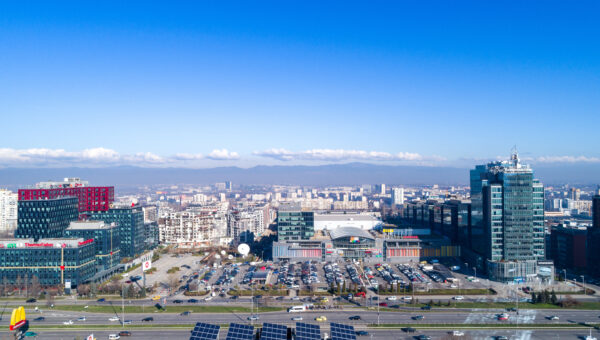
None of this means much in the abstract, so it is worth grounding it in a building that exists. ETC was built to an environmental standard that holds up to scrutiny rather than one assembled for a brochure. All of its buildings hold LEED Platinum certification, which is the highest level of the most established green rating awards, and the entire site runs on 100 percent renewable energy. Behind the walls, intelligent building management systems are constantly reading and adjusting energy use across more than 54,400 square meters of offices. It is, without stretching the word, one of the few buildings in Sofia that has earned the label smart building.
Modern office infrastructure for efficient business operations
Most of the efficiency is down to the engineering, which is the part nobody sees. ETC uses a four-pipe HVAC setup that can heat and cool with some precision, façade glazing built to let daylight through while holding energy in, and windows that open across roughly a third of the building, so getting fresh air does not automatically hand the job to a ventilation system. There are dual independent power sources behind it, redundancy without the usual energy penalty that comes with it. The payoff for a tenant works on two fronts at once: a smaller footprint and operations that simply keep running, the sort of quiet, reliable groundwork that flexible office spaces depend on if they are going to deliver.
Green areas that improve the work environment
The sustainability at ETC does not stop at the plant rooms either. There are outdoor green areas and gardens that were actually designed in, not left over, running between the buildings, and they give people a spot to clear their head partway through something and let a bit of nature into an otherwise indoor day. Easy to dismiss as a minor touch. It is not, particularly: the link between being around greenery and daylight and how people feel at work is by now well established, so these corners are doing real work for the wellbeing of the people there while they also take some of the environmental load off the site.
A sustainable business location for future-focused companies
If a company is thinking beyond the next set of quarterly numbers, the building it picks is partly a wager on where all this is going, and the direction of travel is not really in doubt; it is greener, and it is smarter. Settling into somewhere that already runs on renewable energy and looks after its own consumption, and that happens to sit among the more advanced modern office buildings in Sofia, is one fewer thing to be ripping out and redoing a few years from now. The business gets to line up with its own sustainability goals in the place it turns up to every morning, rather than buying its way to them with offsets once the damage is done. Which is more or less the definition of a location built for what is coming.