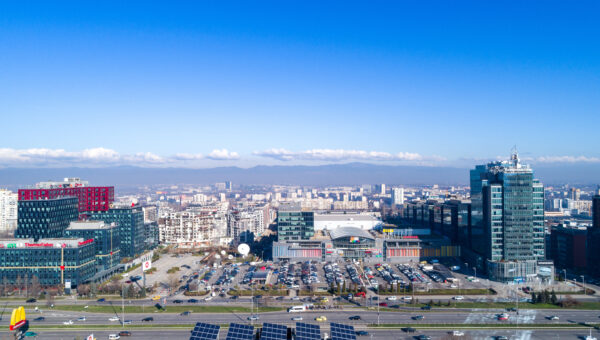
Inside the European Trade Center: A look at Sofia’s premier business complex
Some office environments make sense immediately. Others reveal their value over time, through daily routines rather than first impressions. The European Trade Center belongs to the second category. It functions as a place shaped by real patterns of work, movement, and interaction, rather than by abstract ideas of what an office should look like.
Within this setting, the European Trade Center operates as a business complex where location, scale, and everyday usability come together naturally. The result is an environment that supports how companies actually work, instead of forcing them to adapt to rigid structures.
Why is the European Trade Center a
preferred business center Sofia?
Companies rarely choose an office location based on a single advantage. What matters more is how smoothly everyday logistics unfold once teams are in place. Predictable access, intuitive navigation, and a sense of continuity all play a role in long-term decisions.
Seen as a business center, the European Trade Center offers exactly that kind of stability. Reaching the site is straightforward, visitors find their way easily, and daily routines remain consistent. Over time, these seemingly small details shape productivity and influence why companies choose to stay.
A landmark Sofia complex for business and commerce
Some developments stand out because of how they are used rather than how they are presented. The European Trade Center has become a recognizable complex within the city’s business landscape, largely because it concentrates different activities in one place.
Office work, services, and commercial functions overlap throughout the day. This creates a steady rhythm that extends beyond standard working hours and supports interactions that feel natural rather than scheduled.
A modern business complex designed for growth and efficiency
Growth rarely follows a straight path. Teams change size, structures evolve, and working models adapt over time. Office environments that assume stability often struggle to keep up.
At the European Trade Center, flexibility is built into the way space is used. Layouts can evolve gradually, allowing companies to grow without the disruption of frequent relocation. This approach supports efficiency not through speed, but through continuity.
How does the Sofia complex support daily business operations?
Productivity is often influenced by what surrounds the workspace rather than the workspace itself. Everyday needs, when handled nearby, remove friction from the working day.
At the European Trade Center, access to essential services allows employees to manage tasks without leaving the area. This helps create a balanced rhythm where professional responsibilities and practical needs coexist without unnecessary interruption.
Inside modern office business centers at the ETC
The offices at the European Trade Center are not isolated units. They function as part of a broader environment that reflects how contemporary organizations operate.
Integrated services
Shared services across the site simplify operational routines. Maintenance, technical support, and everyday conveniences are available within the environment, reducing the need for external arrangements and allowing companies to focus on their core work.
Flexible workspaces
Workspaces are designed to adapt as teams and priorities change. This flexibility allows companies to respond to new requirements without compromising location or infrastructure, making the offices suitable for both present and future needs.
Closing reflection
A successful office environment is defined less by appearance and more by how it supports everyday work over time. The European Trade Center succeeds by removing obstacles rather than adding complexity.
As a business center within a well-structured Sofia complex, it offers companies a setting that supports growth quietly and consistently, often the most valuable quality in a long-term location decision.