2026 Work space insights: Is remote work still effective for teams?
Remote work was supposed to end the argument. Hand people control over where they sit, the logic went, and the results would follow. They mostly did, for a while. But a few years in, the honest version is messier: the same setup that lets one team do its best work leaves another slowly coming apart, and effort is almost never the reason why.
By 2026, the question has shifted. Companies have stopped asking whether remote work can work at all. They want to know where it earns its keep, where it starts costing them something they did not budget for, and what kind of work space holds a team together while still leaving people enough quiet to think.
Is Remote Work Still Effective for Teams in 2026?
Yes, but not unconditionally. The proof that remote and hybrid teams can hold their own is no longer a matter of opinion. In 2024, a Stanford team under the economist Nicholas Bloom published a study in Nature that followed more than 1,600 staff through a hybrid trial. Two days at home each week changed nothing measurable about their output, their reviews, or their odds of promotion. Quitting, though, dropped by a third. So on the question of productivity working from home vs office, the cliff that so many managers brace for never really showed up. What is worth arguing about is subtler: which tasks survive the move home, and which quietly start to fray.
Where remote work still works well?
It holds up best when the work is solitary and clearly bounded. Writing. Coding. Analysis, design, account management, the kind of task that rewards an hour of nobody bothering you. Work like that often does better away from the office, and Bloom’s group had already found as much in an earlier study, where solo tasks at home saw a small bump in output, mostly because home was quieter than the floor. Give someone clear ownership, decent tools, and a deliverable they understand, and an efficient work space at the kitchen table can beat a loud open-plan office hands down for deep work.
Challenges that reduce team effectiveness in remote settings
Where it gets harder is the shared, fuzzy stuff. New hires take longer to find their feet, because so much of what you learn in an office you pick up by osmosis, from overhearing how things actually get done. A decision that used to be a thirty-second exchange by the coffee machine becomes a thread, which becomes a call, which becomes a second call to follow up on the first. Pull apart the productivity of remote working vs office and the shortfall almost never sits with the individual. It sits in the joins: handovers, mentoring, the shared context that wears thin when nobody is in the same place. Distributed teams can absolutely stay on top of all this. They just have to work at something office-based teams get handed for nothing.
The importance of physical interaction for team connection
A screen cannot carry everything. Trust builds quicker face to face. Hard conversations go better when you can read a room. And a lot of the collaboration that matters is the kind nobody plans, the shared lunch where someone mentions a problem, the half-finished sketch on a whiteboard that turns into the actual solution. That is not an argument for five days a week at a desk. It is an argument for time together that means something, often enough to count. Let every exchange become a scheduled, purpose-built meeting and the ties that hold people together start to fade, usually before anyone notices they are going.
Why hybrid work is becoming the more practical model?
Hybrid did not win on principle. It won on outcomes. It hangs on to the focus and freedom people get at home, and keeps the in-person time without which teams quietly stop working as teams. Back in that Stanford trial, the managers had a number in mind: hybrid would knock about 2.6 percent off productivity. The number never materialised. By the time it wrapped, plenty of those same managers had swung the other way and reckoned the flexibility might nudge performance up instead. For most knowledge teams, framing this as working from home vs office productivity misses the point now. The real question is not which one. It is how to get both.
Combining flexibility and collaboration through hybrid work
What hybrid really buys you is a week with two gears. Home days are walled off for whatever needs quiet and a long runway. Office days go to the work that only really happens with people in the room, planning, reviewing, thinking out loud, showing a new colleague the ropes. Pulled off properly, none of this feels like settling for the lesser of two bad options. Each kind of work gets the conditions it was always going to need, and that is precisely the thing a fully remote or fully office setup struggles to manage on its own.
The value of focus time and shared office time
Two things teams routinely get wrong about focus time: how much it matters, and how scarce it has become. Being reachable at all hours is not productivity. It only looks like it. A hybrid week that works keeps deep work and collaboration apart on purpose, so that one does not swallow the other whole. Home days protect concentration. Office days open up room for talking things through, for mentoring, for the decisions that move faster when people are in front of each other. It all comes down to intent. Use the shared hours for what genuinely needs the room, not for things half the team could have knocked out on their own at home.
Key considerations when choosing a work model
There is no template here, which is exactly why lifting another company’s policy wholesale tends to backfire. What works for you depends on the work itself, how seasoned the team is, the tooling already in place, and how much of the job lives or dies on coordination. A punishing commute shifts the calculation. So does a steady stream of new hires, or a team whose best ideas tend to surface mid-conversation. And a fair chunk of it comes down to choosing the right office space, because the building is what decides whether anyone thinks the trip in was worth making.
The role of modern office spaces in team productivity
For office days to pull their weight, the office has to pull its own. A modern office space has very little to do with how the interiors photograph. Its job is duller and more useful: clear out the small frictions that bleed a day dry, and set things up so people can concentrate and collaborate without the two forever tripping over each other. Researchers have spelled out the connection for years. Noise, temperature, the way a floor is laid out, what is within reach, all of it leaves a mark on how well people work. Build a workspace around the way a team actually moves through its day, and the in-person half of hybrid gets a great deal easier to run.
Workspaces that support better communication
A lot of communication is really a layout problem in disguise. Go all open plan and every chat becomes someone else’s distraction. Go all closed doors and asking a quick question feels like you are intruding. The floors that get this right hedge their bets: quiet corners for heads-down work, a project table for the short, sharp decisions, somewhere informal where you can settle a question without putting a meeting in the calendar. Match the space to the task and people end up talking when it helps and concentrating when it counts, rather than doing a mediocre job of both at once.
The importance of location and accessibility for employees
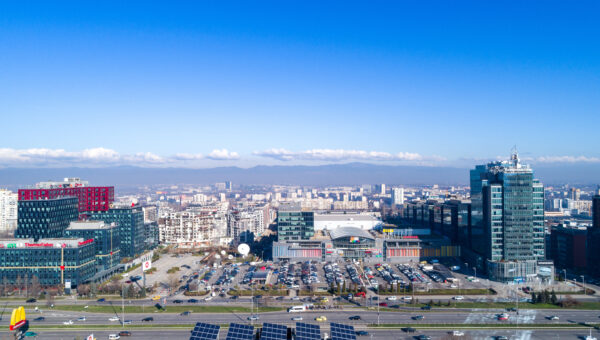
Location bends behavior in a way policies rarely manage. Saddle people with a punishing commute and office days become something to dodge. Make the journey easy and well-connected and, suddenly, they show up. This is where ETC has a built-in edge. It sits on one of Sofia’s main business arteries, roughly seven minutes from the center and three from the airport, with more than thirty bus lines on the doorstep and over 800 parking spaces underground. When getting in is no hassle, the in-person days hybrid leans on are a lot less likely to fall apart over the months that follow.
How do meeting rooms in ETC and shared areas strengthen teamwork?
The in-person half of hybrid stands or falls on shared space. Meeting rooms you can actually find and book without a fight, common areas that pull people into a quick exchange, the odd well-placed informal corner, these are where teams do the work they came in to do. ETC backs that up beyond the meeting itself. Tenants get direct heated access to The Mall, with fifty or so restaurants and cafés and a couple of fitness centers a short walk away, so the day holds together either side of whatever brought everyone in. Those shared areas and on-site amenities are a big part of what makes the journey in feel worth it.
How flexible office solutions support the future of work?
The future of work is not going to land on one tidy, permanent model, and that is the whole case for keeping the office flexible. Teams expand, contract, reinvent how they run. The space around them has to move at the same speed. Flexible office solutions, the kind you can scale up, break down, and rearrange as the need changes, let a business rethink how it works without packing up and moving every time. For anyone running hybrid teams, that is not a nice-to-have anymore. It is what stops the work place from quietly drifting out of step with how people work today, as opposed to how they worked back in 2023.
Benefits of premium office environments
A premium environment pays for itself in the details nobody really clocks until they are missing. Systems that just work, air you do not notice, real daylight, quiet where quiet is wanted, the bank and the pharmacy two minutes away. None of it shouts, but together it strips out the friction that grinds people down by Thursday. And there is hard evidence behind the soft stuff. Oxford researchers found that happier workers were roughly 13 percent more productive, and not because they put in longer hours. So the effects of job satisfaction on productivity are not a feel-good slogan, and a well-run building is one of the blunter, more direct levers a business has to pull on them.
ETC Offices and hybrid teams in Sofia
For a hybrid team in Sofia, the question that matters is plain enough: on the days you ask people to come in, is this somewhere they want to be? ETC was put together with exactly that in mind. More than 54,400 square meters of Class A space across four buildings, anything from a compact unit to a whole floor, all of it on renewable energy and wired into the wider world of The Mall. And as Sofia grows into a genuine hub for modern office buildings, a base this flexible and this well-placed gives a hybrid team somewhere to focus, gather, and grow, all under one roof.